
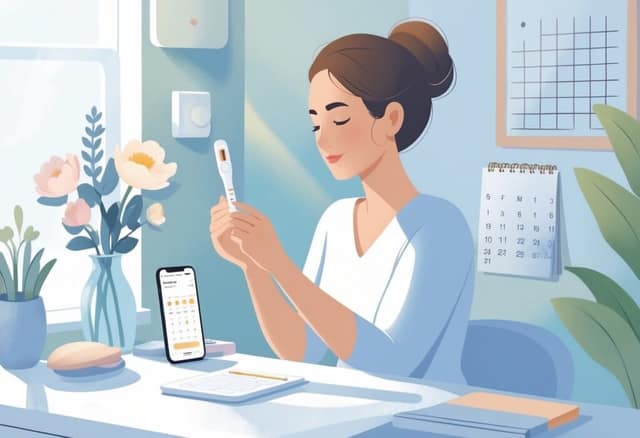
An ovulation predictor kit is a home urine test that detects the luteinizing hormone (LH) surge — the hormonal signal that ovulation will happen within 24 to 36 hours — helping people trying to conceive identify their most fertile days.
If you’re trying to get pregnant, timing is everything. The fertile window lasts only about six days each cycle, and missing it means waiting another month. An ovulation predictor kit takes the guesswork out of that timing.
Ready to start your project?
Join +450,000 members who find their co-parent or sperm donor
Start free✓ Free ✓ No commitment ✓ Verified
Modern kits are accurate, affordable, and easy to use — even for first-timers. According to the 2023 Cochrane review of randomized controlled trials, timed intercourse using urine ovulation tests raises the chance of a live birth from 16% to between 16% and 28% per cycle in women under 40 trying to conceive.
Whether you’re trying naturally, using donor sperm, or planning insemination at home, learning how to use an ovulation predictor kit can shorten your path to pregnancy.
What Is an Ovulation Predictor Kit?
An ovulation predictor kit (OPK) is a home fertility test that measures LH levels in your urine. LH is produced by the pituitary gland and triggers the release of a mature egg from the ovary.
For most of your cycle, LH stays low. About 24 to 36 hours before ovulation, levels spike sharply — this is the LH surge. Catching that surge tells you the next two days are your peak fertility window.
Unlike fertility tracking based only on calendar estimates or body temperature, an OPK offers a direct hormonal signal. That’s especially useful for women with irregular cycles or those who find symptom-tracking confusing.
How Does an Ovulation Predictor Kit Work?
Each kit contains test strips, sticks, or cassettes treated with antibodies that react to LH. When you dip the test in urine (or hold it in your stream), the antibodies bind to the hormone and produce a visible line — or, on digital kits, a smiley face or clear “yes/no” result.
The National Institutes of Health medical encyclopedia notes that a positive OPK result means ovulation should occur within the next 24 to 36 hours. You’ll want to plan intercourse or insemination immediately — ideally within the first 24 hours after the positive test, and again the following day.
The science is simple, but accuracy depends on consistent, well-timed testing. Skipping a day or diluting your urine with excess water can cause you to miss the surge entirely.
The 4 Main Types of Ovulation Predictor Kits
Not all OPKs are the same. Here are the most common options — each with its own strengths.
1. Standard LH Test Strips
These are the most affordable OPKs on the market, often sold in bulk packs of 30 to 100 strips. You dip the strip into collected urine for a few seconds, then wait 5 minutes for the result. A test line as dark as — or darker than — the control line indicates a positive.
Best for: Budget-conscious users and anyone comfortable reading line tests. Strips usually cost $0.50 to $1 each when purchased in bulk.
2. Digital Ovulation Tests
Digital kits remove the guesswork. Instead of interpreting line shades, you see a smiley face, a yes/no message, or a peak-fertility icon. Brands like Clearblue and First Response lead this category.
Digital tests typically cost $1.50 to $3 per test. However, they are easier to read and reduce the risk of misinterpreting faint lines.
Best for: First-time users and people who want clear, unambiguous results.
3. Dual-Hormone Digital Monitors
Advanced digital monitors, such as the Clearblue Advanced Fertility Monitor, track both LH and estrogen. This dual-hormone approach identifies up to 6 fertile days per cycle instead of only 2.
These monitors cost $150 to $200, plus refill sticks. They’re particularly helpful for women with shorter fertile windows or irregular timing.
Best for: Women who have been trying for several months without success.
4. App-Connected Smart OPKs
Newer kits like Premom, Proov, and Inito connect to smartphone apps that photograph and interpret test strips automatically. Some also measure progesterone metabolites (PdG) to confirm that ovulation actually occurred — not just that LH surged.
Best for: Data-driven users, women with PCOS, or anyone who wants long-term cycle insights.
Ovulation Predictor Kit Comparison (2026)
| Type | Average Price | Fertile Days Detected | Ease of Use | Best For |
|---|---|---|---|---|
| Standard LH strips | $0.50–$1 each | 1–2 | Moderate | Budget tracking |
| Digital tests | $1.50–$3 each | 1–2 | Easy | Beginners |
| Dual-hormone monitors | $150–$200 + refills | Up to 6 | Easy | Longer TTC journeys |
| App-connected kits | $30–$100 + app subscription | Varies | Easy | Detailed tracking |
How to Use an Ovulation Predictor Kit: Step by Step
Using an ovulation predictor kit the right way dramatically improves accuracy. Follow these steps.
1. Know your cycle length. Count from day 1 of your period to day 1 of the next period. If you have a 28-day cycle, start testing on day 11. For shorter or longer cycles, subtract 17 from your cycle length to find the start date.
2. Test at the same time every day. Mid-morning to early afternoon (around 10 a.m. to 2 p.m.) works best for most women. Avoid first-morning urine — LH is released in a pattern that often isn’t detectable until later in the day.
3. Limit fluid intake for 2 hours before testing. Excess water dilutes your urine and can mask the LH surge.
4. Follow the package instructions precisely. Dip strips for the exact number of seconds indicated, then lay them flat while developing.
5. Test once or twice daily. Twice-daily testing helps catch rapid surges that could otherwise be missed. This is especially useful in the days surrounding expected ovulation.
6. Act on a positive result. Once you see a positive, have intercourse or schedule insemination that same day and the next. The fertile window closes within 24 to 48 hours.
How to Read Your Ovulation Predictor Kit Results
Reading a test strip is straightforward once you know what to look for. Every OPK has two lines: a control line (which always appears to confirm the test worked) and a test line.
- Negative: The test line is lighter than the control line, or doesn’t appear.
- Positive (LH surge): The test line is as dark as — or darker than — the control line.
- Invalid: No control line appears. Discard and retest.
Digital kits bypass this entirely. A smiley face, “peak” indicator, or solid symbol means ovulation is imminent.
Once you get a positive, ovulation typically occurs within 12 to 48 hours. Plan conception activities accordingly.
Common Factors That Can Affect OPK Accuracy
Even the best ovulation predictor kit isn’t foolproof. Several factors can skew results.
Polycystic ovary syndrome (PCOS). Women with PCOS often have chronically elevated LH, which can produce false positives throughout the cycle. If you have PCOS, consider using a dual-hormone monitor or confirm ovulation with progesterone (PdG) testing.
Fertility medications. Clomiphene citrate (Clomid) raises LH levels artificially. Human chorionic gonadotropin (hCG) trigger shots can cross-react with OPKs and produce misleading results.
Hormonal birth control. If you’ve recently stopped the pill, patch, or ring, your cycles may be irregular for 2 to 3 months. OPK results during this adjustment period can be unreliable.
Menopause and perimenopause. LH levels naturally rise during the menopausal transition, which can produce persistent false positives.
Testing errors. Drinking large amounts of water, testing at inconsistent times, or using expired strips all reduce accuracy.
When to Use an OPK with Donor Sperm or Co-Parenting
For women conceiving with donor sperm — whether through a sperm bank, a known donor, or at-home insemination — timing is absolutely critical.
Frozen donor sperm has a shorter viability window than fresh sperm in the body (around 12 to 24 hours versus up to 5 days). You need to inseminate as close to ovulation as possible.
A positive OPK gives you a precise 24-to-36-hour lead time to coordinate with your donor or schedule a clinic appointment. Many women pair their OPK routine with ovulation cycle tracking and cervical mucus observation for maximum accuracy.
If you’re just starting your parenthood journey or looking for a trusted donor, CoParents.com connects women with screened sperm donors and co-parents in a safe, supportive community.
When to See a Fertility Specialist
Home monitoring is powerful, but it doesn’t replace medical evaluation. Consider consulting a reproductive endocrinologist if:
– You’re under 35 and have been trying for 12 months without success
– You’re 35 or older and have been trying for 6 months without success
– Your cycles are shorter than 21 days or longer than 35 days
– Your OPK never shows a positive result across multiple cycles
– You have known conditions like endometriosis, thyroid disease, or PCOS
A specialist can run blood tests, ultrasound scans, and semen analysis to identify underlying issues. Some preliminary steps may help before starting treatment.
Frequently Asked Questions About Ovulation Predictor Kits
When should I start testing with an ovulation predictor kit?
Start testing about 3 to 5 days before your expected ovulation. For a 28-day cycle, that means day 11. For shorter or longer cycles, subtract 17 from your cycle length. If your cycles are very irregular, begin testing earlier and continue until you get a positive result — most kits include 10 to 20 strips for this reason.
How accurate is an ovulation predictor kit?
Most ovulation predictor kits are over 99% accurate at detecting the LH surge in the urine, according to manufacturer data. However, detecting a surge doesn’t always mean ovulation will actually occur — conditions like PCOS or luteinized unruptured follicle syndrome can trigger LH surges without egg release. Pairing an OPK with basal body temperature or progesterone testing increases confidence.
Can I get pregnant after a positive ovulation predictor kit result?
Yes, a positive OPK is one of the best indicators for timing conception. Ovulation typically happens 12 to 48 hours after the positive result. Have intercourse or perform insemination on the day of the positive test and the following day to maximize your chances.
What time of day is best to use an ovulation predictor kit?
Most experts recommend testing between 10 a.m. and 2 p.m. LH is released in pulses throughout the day, and it takes several hours for a surge to appear in urine. Avoid first-morning urine, and limit fluid intake for 2 hours before testing to keep results concentrated.
Are digital ovulation tests more accurate than strips?
Digital and strip tests both measure the same hormone (LH) with similar sensitivity. The main difference is readability — digital kits show unambiguous smiley faces or clear “yes/no” results, while strips require interpreting line darkness. If you find line tests confusing, a digital ovulation predictor kit is worth the extra cost.
How much does an ovulation predictor kit cost?
Prices vary widely. Basic LH strips cost $0.50 to $1 each when bought in bulk. Digital tests run $1.50 to $3 per test. Advanced dual-hormone monitors cost $150 to $200 upfront, plus recurring refills. App-connected smart kits range from $30 to $100 plus optional subscriptions. Budget around $30 to $80 for a full month of testing.
Start Your Fertility Journey with Confidence
An ovulation predictor kit is one of the most accessible tools you have to take control of your conception timeline. Combined with donor matching, co-parenting planning, or partner support, it can significantly shorten the time to pregnancy.
Ready to find a sperm donor or co-parent who shares your vision? Join CoParents.com to connect with trusted donors and become part of a community that has supported families worldwide since 2008.