
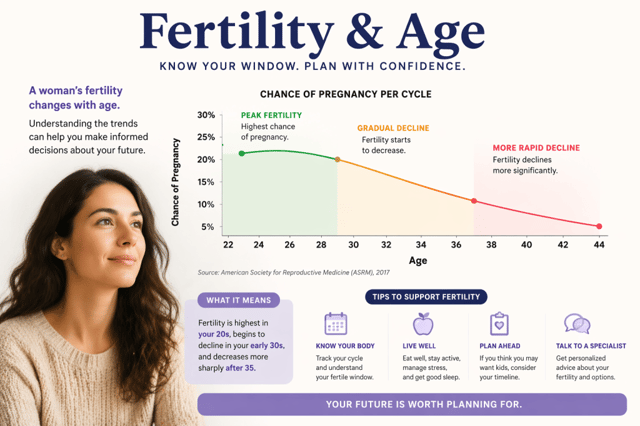
Fertility age refers to the window during which a person can reproduce naturally — and for women, that window narrows significantly after 35. Understanding how age shapes your ability to conceive helps you plan a family on your own timeline, whether you’re trying now or weighing your options for later.
Female fertility peaks in the early 20s, declines gradually through the 30s, and drops sharply after 37. For men, sperm production continues throughout life, but quality declines too — just more slowly. If you’re thinking about starting a family, knowing the facts about fertility and age puts you in control.
What Is Fertility Age and Why Does It Matter?
Fertility age is the biological timeframe during which conception is possible. For women, this window opens at puberty and closes at menopause — on average around age 51 in the United States.
Ready to start your project?
Join +450,000 members who find their co-parent or sperm donor
Start free✓ Free ✓ No commitment ✓ Verified
According to the American Society for Reproductive Medicine, relative fertility is decreased by about half at age 40 compared to women in their late 20s and early 30s.
This isn’t just about getting pregnant. Fertility age also affects miscarriage risk, chromosomal abnormalities, and the chances of carrying a healthy pregnancy to term. The earlier you understand these numbers, the better you can plan — whether that means starting now, freezing eggs, or considering donor options.
How Female Fertility Changes with Age
Women are born with all the eggs they’ll ever have. According to StatPearls data published by the National Library of Medicine, the number of oocytes drops from 6–7 million in utero to 1–2 million at birth, 300,000–500,000 at puberty, 25,000 at age 37, and around 1,000 at age 51.
Here’s how pregnancy chances shift across the decades:
Fertility in Your 20s
This is your biological prime. A healthy 25-year-old woman has roughly a 25% chance of conceiving each month with timed intercourse. Most couples conceive within 6 months of trying.
Miscarriage rates are also at their lowest — around 10% per pregnancy. Chromosomal abnormalities like Down syndrome occur in about 2% of births to women under 25.
Fertility in Your Early 30s
Fertility begins to decline gradually around age 32. Monthly conception chances drop to about 20%, and it may take slightly longer to get pregnant — typically 6 to 12 months.
This is still a strong reproductive window. However, women planning children later should consider preconception counseling or ovarian reserve testing, especially if they want multiple children.
Fertility After 35
After 35, the decline accelerates. Monthly conception chances fall to around 15%, and by 37, oocyte numbers drop sharply. ASRM guidelines recommend earlier fertility evaluation — after just 6 months of trying — for women aged 35 and older, rather than the standard 12-month threshold.
Miscarriage rates also climb. They reach 13.7% at ages 35–37 and 19.8% at ages 38–40, according to data from IVF cycles.
Fertility After 40
By age 40, natural monthly fertility drops below 10%. At 43, it’s under 5%. Aneuploidy rates — chromosomal errors in eggs — increase dramatically, with up to 85% of eggs from women over 42 being chromosomally abnormal.
Women over 40 seeking pregnancy should consult a reproductive endocrinologist immediately rather than wait.
Fertility by Age Chart (2026 Data)
| Age | Monthly Conception Rate | Miscarriage Rate | Oocyte Count |
|---|---|---|---|
| 20–24 | ~25% | ~10% | 300,000+ |
| 25–29 | ~20–25% | ~11% | ~200,000 |
| 30–34 | ~15–20% | ~11–14% | ~100,000 |
| 35–37 | ~15% | ~14% | ~25,000 |
| 38–40 | ~10% | ~20% | ~10,000 |
| 41–42 | ~5% | ~30% | ~5,000 |
| 43+ | <5% | ~37%+ | ~1,000–3,000 |
Why Does Female Fertility Age Decline So Sharply?
Female fertility age decline has two main drivers: falling egg quantity and declining egg quality.
Egg quantity — called ovarian reserve — decreases every month through a process called atresia. Unlike men, women cannot produce new eggs. Once the supply is gone, menopause begins.
Egg quality refers to the genetic health of the remaining eggs. As eggs age, they’re more likely to develop chromosomal errors during meiosis. The American College of Obstetricians and Gynecologists notes that aneuploidy risk increases 10-fold after age 40 compared to women under 25.
Other contributing factors include:
- Declining hormone levels (estrogen, inhibin B, anti-Müllerian hormone)
- Rising follicle-stimulating hormone (FSH), which signals ovarian aging
- Changes in uterine receptivity
- Increased risk of conditions like fibroids and endometriosis
Does Male Fertility Decline with Age?
Yes, but much more gradually. Men produce sperm continuously throughout life, and fathers in their 70s and 80s are not rare. However, male fertility age matters more than previously thought.
Research shows sperm quality changes noticeably after 35. Sperm count, motility, and morphology all decline with age. Men over 45 have higher rates of DNA fragmentation in sperm, which can affect embryo development and increase miscarriage risk.
Paternal age over 40 is also linked to slightly higher risks of certain conditions in offspring, including autism spectrum disorder and schizophrenia. These increases are modest but statistically measurable.
How to Check Your Fertility Age at Home and at the Clinic
Several tests can estimate where you stand on the fertility age curve.
1. Anti-Müllerian Hormone (AMH) blood test. AMH reflects the number of eggs remaining in your ovaries. It’s the gold standard for assessing ovarian reserve. AMH declines steadily from age 25 onward.
2. Follicle-stimulating hormone (FSH) test. Done on day 2 or 3 of your cycle, FSH rises as ovarian reserve falls. High FSH suggests diminished fertility.
3. Antral follicle count (AFC). A transvaginal ultrasound counts visible follicles — another marker of egg supply.
4. Home fertility tests. Some consumer kits offer finger-prick AMH measurement with lab-processed results. They’re useful starting points, but should be followed up with a specialist for accurate interpretation.
5. Ovulation tracking. Using an ovulation predictor kit helps you identify fertile days and confirm you’re ovulating regularly — a basic indicator of reproductive health.
7 Proven Ways to Optimize Fertility at Any Age
You can’t reverse biological aging, but you can maximize what you have. Here’s what the evidence supports.
Quit smoking. Smokers reach menopause about 1 year earlier than non-smokers. Nicotine damages oocyte DNA in women and increases free radicals in seminal fluid in men. Both effects reduce conception chances.
Maintain a healthy weight. Obesity and underweight both disrupt ovulation. A BMI between 20 and 25 optimizes hormone balance and pregnancy chances.
Limit alcohol. Heavy drinking affects sperm quality and disrupts female hormone cycles. Stick to no more than 1–2 drinks per week when trying to conceive, and zero during pregnancy.
Watch your caffeine. Studies suggest more than 300 mg of caffeine daily (about 3 cups of coffee) may slightly reduce fertility. Aim for 200 mg or less.
Manage stress. Chronic stress elevates cortisol, which can suppress ovulation and libido. Yoga, meditation, and consistent sleep help.
Get moving — but not too much. Moderate exercise supports fertility; excessive endurance training can disrupt cycles in women.
Eat a fertility-friendly diet. Mediterranean-style diets rich in fruits, vegetables, whole grains, fish, and healthy fats are associated with better fertility outcomes in both sexes.
Fertility Preservation: Is Egg or Sperm Freezing Right for You?
If you’re not ready for children but worried about fertility age, preservation is a real option. The technology has matured significantly over the past decade.
Egg freezing (oocyte cryopreservation). Women under 35 who freeze around 15 eggs have an 85.2% probability of a live birth later, according to StatPearls analysis. Costs in the US typically range from $10,000 to $20,000 per cycle, plus $500–1,000 annually for storage.
Embryo freezing. More effective than egg freezing, but requires a partner or donor sperm at the time of freezing.
Sperm freezing. Simple, inexpensive ($300–500 per sample), and highly effective. Ideal for men facing medical treatments or considering delayed fatherhood.
Donor options. Using donor eggs, sperm, or embryos is another path. Success rates depend on the donor’s age, not the recipient’s — making this a strong option for women over 40. For those considering donor sperm, understanding the sperm bank process is a good first step.
When to See a Fertility Specialist Based on Your Age
ASRM guidelines are clear on timing. Consult a reproductive endocrinologist if:
- Under 35: You’ve been trying for 12 months without success
- 35–40: You’ve been trying for 6 months without success
- Over 40: Seek evaluation immediately when you start trying
You should also consult earlier if you have irregular periods, a history of endometriosis or PCOS, pelvic pain, previous miscarriages, or known male-factor issues.
Frequently Asked Questions About Fertility Age
What is the best fertility age for women?
The best fertility age for women is the early-to-mid 20s, when both egg quantity and quality are at their peak. Monthly conception chances are around 25%, miscarriage risk is lowest, and chromosomal abnormalities are rare. That said, most women in their late 20s and early 30s still have strong fertility and can conceive without difficulty.
Can I get pregnant naturally after 40?
Yes, natural pregnancy after 40 is possible but statistically uncommon. Monthly conception rates drop below 10%, and miscarriage risk climbs above 30%. If you’re trying over 40, see a fertility specialist immediately rather than waiting. Options like IVF, donor eggs, or co-parenting arrangements can help.
How does male age affect fertility?
Male fertility declines more slowly than female fertility, but it does decline. After age 40, sperm count, motility, and DNA integrity decrease. Paternal age over 45 is also associated with slightly higher miscarriage rates and modestly increased risks of certain conditions in offspring. Semen analysis is a simple test that reveals sperm quality.
What is the oldest fertility age for women?
Natural pregnancy becomes extremely rare after 45 and essentially impossible after menopause (average age 51). With donor eggs, however, pregnancy can be achieved at much older ages — some women carry healthy pregnancies into their 50s using IVF with donor oocytes, since the uterus remains receptive even when ovarian function has ceased.
Does freezing eggs reverse fertility age decline?
Not exactly — but it preserves your eggs at their current quality. Freezing eggs in your late 20s or early 30s means future fertility treatments can use those younger, higher-quality eggs even if you try to conceive in your 40s. The eggs themselves don’t age while frozen.
Can lifestyle changes slow fertility age decline?
Healthy habits like not smoking, maintaining a normal weight, limiting alcohol, and managing stress can optimize your baseline fertility. However, lifestyle cannot reverse the natural decline in egg quantity and quality that comes with age. The ASRM is clear: no amount of exercise, diet, or supplements will offset biological aging of the ovaries.
Take Charge of Your Fertility Journey
Fertility age is one of the most important factors in family planning — but it’s not the only one. Whether you’re 25 or 45, trying with a partner, considering donor sperm, or exploring co-parenting, you have options.
Ready to take the next step? Join CoParents.com to find a sperm donor or co-parent and become part of a trusted community supporting parenthood journeys worldwide since 2008.