
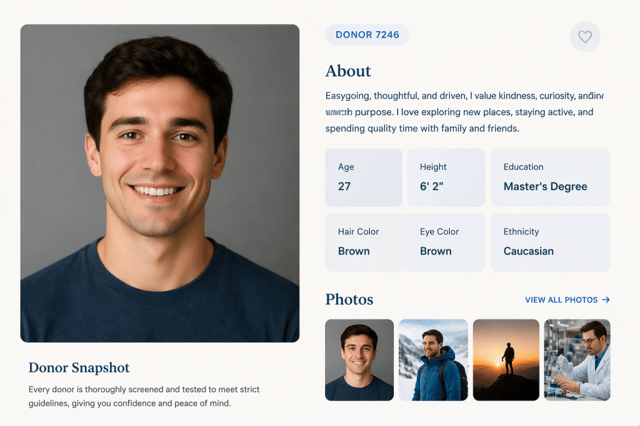
A sperm donor profile is the first impression that determines whether aspiring parents will contact you — or scroll right past. In just a few hundred words and one photo, you need to communicate who you are, what you’re offering, and why you’re trustworthy. Most recipients spend less than 30 seconds deciding whether to open a profile. Therefore, what you write and how you present yourself matter enormously.
Before drafting anything, step back and think about the people on the other side of the screen. They are making one of the most consequential decisions of their lives: who will help them create a child. A well-built sperm donor profile respects that weight. It’s honest, specific, and focused on what recipients genuinely need to know.
Why does a sperm donor profile matter so much?
Recipients browsing platforms like CoParents are looking for signals. They want to know that you’re real, healthy, emotionally stable, and aligned with their expectations. A vague or careless sperm donor profile creates doubt. A thoughtful one builds trust before the first message is exchanged.
Ready to start your project?
Join +450,000 members who find their co-parent or sperm donor
Start free✓ Free ✓ No commitment ✓ Verified
Moreover, the quality of your profile filters your incoming messages. Clear expectations attract compatible recipients. Ambiguity attracts mismatches and wasted conversations. Consequently, spending an extra hour on your profile saves weeks of unproductive exchanges later.
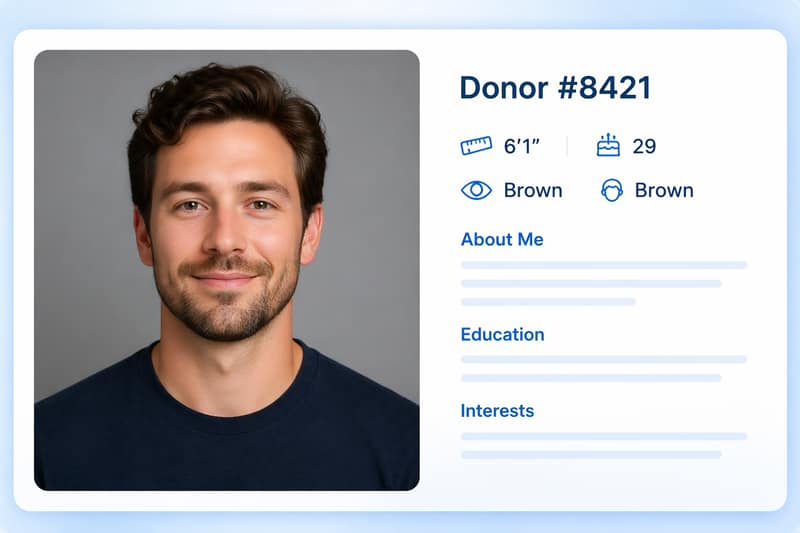
10 essential elements of a great sperm donor profile
The checklist below is built from what actual recipients search for and what platforms know drives matches. Cover each item honestly, and your profile will rank among the strongest on any donor platform.
1. State your expectations clearly
This is the single most important section of your sperm donor profile. Recipients want to know immediately what kind of relationship you’re offering. Are you a pure donor with no contact after conception? A known donor willing to answer medical questions as the child grows? Or are you open to co-parenting and active involvement?
Equally important: specify your donation method. Are you offering artificial insemination (AI) only, natural insemination (NI), or are you flexible? Are you willing to travel, and if so, how far? Vague answers frustrate recipients. Specific answers attract the right ones.
2. Your age
Age matters more than many donors realize. According to research published in a systematic review in Reproductive BioMedicine Online covering 93,839 men, sperm volume, motility, and DNA integrity all decline significantly with advancing paternal age, and these changes can affect fertilization rates and pregnancy outcomes. ASRM recommends that sperm donors ideally be between 21 and 40 years old.
State your age honestly. Recipients have a right to know, and any deception on this point will destroy trust the moment it surfaces.
3. Your donation experience
Have you donated before? How many times? How many successful pregnancies resulted? This matters on two fronts. First, it tells recipients whether their future child will have half-siblings already in the world. Second, proven fertility is a meaningful reassurance in any sperm donor profile.
If you’re new to donation, say so. First-time donors are welcome on most platforms — honesty is what recipients value.
4. Your location
Distance determines logistics. List your city or region (not your full address) so recipients can quickly assess whether you’re reachable. Mention whether you’re open to traveling, hosting, or meeting at a clinic. A sperm donor profile without location information gets filtered out of most searches automatically.
5. Your motivation for donating
Why are you doing this? Recipients care deeply about motivation because it signals character. Are you donating because a friend or family member struggled with infertility? Because you believe everyone deserves a chance at parenthood? Because you want to help same-sex couples or single mothers by choice?
Tell your story briefly — two or three sentences. Aspiring parents connect with genuine personal motivation far more than with generic statements. However, avoid making financial compensation your primary stated reason; it raises immediate red flags for serious recipients.
6. Your personality
You’re sharing DNA with someone’s future child. That reality makes your personality relevant in a way that feels unusual to talk about publicly, but it matters.
Are you introverted or extroverted? Optimistic or analytical? Do you have a sharp sense of humor or a calm, patient temperament? Recipients use these details to form a mental picture and, where possible, to imagine traits their child might inherit. Scientists still debate how strongly genes shape personality, but the signal value to recipients is undeniable.
7. Your hobbies and interests
Hobbies humanize a sperm donor profile faster than anything else. Do you cycle, cook, hike, read, paint, play an instrument, or run marathons? Share what actually matters to you.
Many recipients specifically look for donors who share their own interests, believing (rightly or wrongly) that shared passions make the donor feel closer to their family. Be specific: “I play classical piano and compete in amateur chess tournaments” lands far better than “I like music and games”.
8. Your education and career
This is one of the most searched fields across donor platforms. Recipients often use education and profession as proxies for curiosity, discipline, and long-term thinking. You don’t need advanced degrees to create a strong sperm donor profile — honest descriptions of skilled trades, creative professions, and technical work perform equally well. What matters is specificity.
Avoid exaggeration. Recipients sometimes verify claims, and discovering an inflated credential will end a match immediately.
9. A high-quality recent photo
Profiles without photos get roughly 70% less engagement than profiles with them. A clear, recent picture of your face is non-negotiable for serious recipients.
Some guidelines for the photo itself:
- Natural daylight, not harsh indoor lighting
- Direct eye contact with the camera
- No sunglasses, no caps pulled low, no hair covering your face
- Friendly expression — a genuine smile beats an intense stare every time
- Solo shot, not cropped from a group photo
- Recent (within the last year)
Avoid shirtless gym mirrors, filtered selfies, and anything that looks like a dating app. You want to look trustworthy, stable, and genuinely approachable.
10. A trustworthy username
Your username is part of your sperm donor profile whether you think about it or not. It should be short, easy to remember, and absolutely never suggestive, sexual, or flirty. Usernames like “StudDad85” or “BabyMakerNYC” are immediate disqualifiers for the majority of serious recipients.
Aim for something simple: a first name combined with an interest (“JamesRuns”), a regional identifier (“DenverDonor”), or a neutral word pair. Never use your full legal name — this protects your privacy and keeps the platform’s safety features working correctly.
What to avoid in your sperm donor profile
Even experienced donors make these mistakes. Avoiding them puts you ahead of most of the competition:
- Generic descriptions: “I’m a nice guy who wants to help” says nothing. Be specific or don’t write it.
- Overstatement: Claiming elite degrees, athletic achievements, or IQ scores you can’t back up.
- Financial focus: Recipients are suspicious of donors whose primary motivation is money.
- Vague donation method: “Open to anything” sounds unserious. Specify what you’ll actually do.
- Typos and sloppy writing: First impressions count, and errors suggest carelessness on something serious.
- Pressuring language: Anything that reads as impatient or transactional turns recipients away.
Medical screening matters more than your profile
A polished sperm donor profile gets you noticed, but medical screening is what closes the deal with serious recipients. The American Society for Reproductive Medicine’s 2024 gamete donation guidance states that known or directed donors should undergo the same infectious disease screening and testing as anonymous donors, and psychological evaluation is strongly recommended for all sperm donors.
Be ready to provide recent test results for HIV, hepatitis B and C, syphilis, chlamydia, gonorrhea, HTLV, and CMV. Many recipients will also ask about genetic carrier screening for conditions like cystic fibrosis and spinal muscular atrophy. Mentioning that you’re willing to complete full medical screening is a strong trust signal in your profile.
How to handle your first contact
A great sperm donor profile is only step one. When recipients reach out, your first reply sets the tone for everything that follows. Respond within 24 to 48 hours when possible. Be warm but measured. Ask about their situation and listen carefully before launching into your own story.
The CoParents platform connects donors and recipients across multiple countries, and members consistently report that the most successful matches start with honest profiles followed by respectful, patient conversations. There is no rush — take the time both parties need.
Frequently Asked Questions
How long should a sperm donor profile be?
Aim for 300 to 500 words of profile text — long enough to cover the essentials, short enough that recipients will actually read it. Each section should be two or three sentences at most. Recipients skim; they don’t read essays.
Should I share my real name in my sperm donor profile?
No. Use a username and a first name only. Sharing your full legal name publicly removes privacy protections that the platform provides and exposes you to unnecessary risk. You can share more once a genuine connection is established and both parties agree to exchange identifying information.
What should I say about my motivation without sounding fake?
Be specific and personal. Instead of writing “I want to help people”, describe a real moment: a friend who struggled with infertility, a family experience, a moment of reflection that led you here. Specificity always reads as authentic; generic phrases always read as filler.
How often should I update my sperm donor profile?
Review your profile every three to six months. Update your photo if more than a year has passed, refresh the number of donations and pregnancies, and revise your expectations if they’ve shifted. An outdated profile makes you look inactive even when you’re still searching.
Do recipients really care about hobbies and personality?
Yes. These details may matter less biologically than your medical history, but they matter enormously in the decision-making process. Recipients want to imagine who you are as a person, not just as a source of DNA. A sperm donor profile that captures personality stands out in a sea of sterile, fact-only listings.
Ready to create your profile and connect with recipients?
A strong sperm donor profile is your introduction to the people you might help bring a child into the world. Take it seriously, be honest, and present yourself the way you’d want to be seen. If you’re ready to start helping aspiring parents build their families, join CoParents to find a recipient and create the profile that could change lives — including, eventually, your own.