
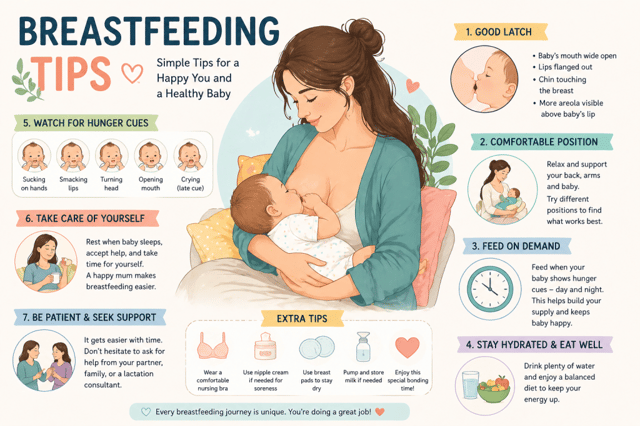
Looking for breastfeeding tips that actually work? You are in good company. About 86% of US moms start out breastfeeding, but only 1 in 4 reaches the 6-month exclusive mark recommended by the CDC, the American Academy of Pediatrics, and the WHO. The gap between intention and reality is rarely about willpower — it is almost always about practical breastfeeding tips that someone forgot to mention before discharge.
This guide walks through the most useful evidence-based breastfeeding tips for the most common challenges: sore nipples, latching problems, low milk supply, engorgement, and breast infections. Whether you are a first-time mom, a single mother by choice, or a co-parent supporting your partner, these breastfeeding tips will help you avoid the dropout cliff that hits most new moms in the first 6 weeks.
Why Breastfeeding Tips Matter From Day One
Breast milk delivers a custom-built blend of nutrients, antibodies, and growth factors that adapts as your baby grows. According to the CDC’s overview of breastfeeding benefits, breastfed babies have lower risks of asthma, ear infections, gastrointestinal infections, type 1 diabetes, obesity, and sudden infant death syndrome (SIDS). Mothers who breastfeed also have lower lifetime risks of breast cancer, ovarian cancer, type 2 diabetes, and high blood pressure.
Ready to start your project?
Join +450,000 members who find their co-parent or sperm donor
Start free✓ Free ✓ No commitment ✓ Verified
Despite these benefits, breastfeeding is a learned skill — for both mom and baby. Most challenges happen in the first 2 to 6 weeks and most are solvable. Knowing what to expect and which breastfeeding tips to apply early is what separates moms who keep going from those who switch to formula earlier than they wanted.
Breastfeeding Tip 1: Master the Latch From the First Feed
A good latch is the single most important factor in pain-free, productive breastfeeding. According to the American Pregnancy Association’s guide on breastfeeding latch, a baby who is latched only on the nipple instead of the surrounding areola will cause sore nipples and inefficient feeding within hours.
These breastfeeding tips help you check the latch in real time:
| Sign | Good Latch |
|---|---|
| Mouth opening | Wide, like a yawn |
| Lip position | Both lips flanged outward like fish lips |
| Areola coverage | More of the lower areola in baby’s mouth than the upper |
| Cheeks | Rounded, not dimpled |
| Sounds | Swallowing audible, no clicking |
| Pain level | Brief pinch at start, then comfort |
| Chin | Touching the breast |
If something feels off, gently break the suction by sliding a clean finger into the corner of your baby’s mouth and try again. Do not push through the pain — bad latches damage nipples fast.
Breastfeeding Tip 2: Treat Sore Nipples Before They Crack
Sore nipples are the most common early problem and one of the top reasons US moms quit breastfeeding before they wanted to. The Office on Women’s Health guide on common breastfeeding challenges recommends:
- Apply expressed breast milk to the nipple after each feed and let it air-dry. Breast milk contains natural antibodies and skin softeners that promote healing.
- Use purified lanolin cream or ointment specifically made for breastfeeding between feeds.
- Let nipples air-dry after each feed, or wear a soft cotton shirt without a bra when at home.
- Change nursing pads often and avoid pads with plastic backing, which trap moisture.
- Avoid harsh soaps and astringents — clean water is enough.
If nipples are cracked, bleeding, or worsening despite these breastfeeding tips, see a lactation consultant within 24 to 48 hours. Persistent pain is a sign of latch issues, thrush, or vasospasm — all treatable but worth a professional eye.
Breastfeeding Tip 3: Find Your Best Position
There is no single right position. The best one is whichever lets you and your baby relax with a deep latch. The four most common holds:
| Position | Best For |
|---|---|
| Cross-cradle hold | New moms learning the latch; gives the most control |
| Cradle hold | Confident feeding once latch is established |
| Football hold | Cesarean recovery, large breasts, or twins |
| Side-lying | Night feeds, recovery from delivery, exhausted moms |
Use pillows generously. A good breastfeeding pillow lifts your baby to breast level so you are not hunching over for 30 minutes at a time. Hunching wrecks your back and the angle wrecks the latch.
Breastfeeding Tip 4: Handle Inverted or Flat Nipples
Inverted or flat nipples make initial latching harder, but they almost never make breastfeeding impossible. Several techniques work:
- Manually elevate the nipple by gently rolling it between thumb and forefinger before offering.
- Use a breast pump for 1 to 2 minutes before each feed to draw out the nipple.
- Try a nipple shield (a thin silicone cover) under guidance from a lactation consultant — temporary use only.
- Be patient: as your baby grows, their mouth gets bigger and the latch gets easier. Many flat-nipple moms have a smooth experience by week 4 to 6.
Breastfeeding Tip 5: Protect Your Milk Supply
Most moms make plenty of milk for their babies. The fastest way to lose your supply is to cut feedings, supplement formula too early, or introduce pacifiers before breastfeeding is established.
These breastfeeding tips also help you spot the real signs of low milk supply (per CDC and lactation consultant criteria):
- Fewer than 6 wet diapers per day after day 5.
- Dark yellow or orange urine in baby.
- Inadequate weight gain confirmed by your pediatrician.
- Fewer than 3 to 4 stools daily in the first 6 weeks.
- Persistent fussiness even after long feeds.
Apply these supply-saving breastfeeding tips:
- Feed on demand, both breasts, as often and as long as your baby wants. Aim for 8 to 12 feeds in 24 hours in the early weeks.
- Avoid pacifiers and bottles until breastfeeding is well established (typically 3 to 4 weeks).
- Stay hydrated and well-fed yourself — your body needs the calories.
- Limit alcohol and avoid smoking. Both reduce milk supply.
Soft breasts after the first few weeks are normal — your supply has adjusted to demand, not vanished. If concerns persist, see a lactation consultant before reaching for formula.
Breastfeeding Tip 6: Manage Engorgement Before It Becomes Mastitis
Engorgement — overly full, swollen, painful breasts — usually peaks around days 3 to 5 as your milk fully comes in. Untreated engorgement can lead to clogged ducts and mastitis (breast infection), so these breastfeeding tips matter.
Frequent feeding (every 2 to 3 hours) is the best prevention. If engorgement still hits:
- Massage the breast gently from chest wall toward the nipple while feeding.
- Apply a warm compress or take a warm shower right before feeding to encourage letdown.
- Apply a cold compress or chilled cabbage leaves between feeds to reduce swelling.
- Hand-express or pump just enough milk to relieve pressure — but not so much that you signal more production.
- Wear a supportive but not tight bra. Avoid underwires during this phase.
Breastfeeding Tip 7: Know When You Have Mastitis
Mastitis hits about 1 in 10 breastfeeding mothers and feels like the flu plus a hot, tender, red wedge in one breast. Symptoms include fever above 101°F, chills, body aches, nausea, and a hard, painful area in the breast.
What to do immediately:
- Keep breastfeeding from the affected side — this is safe for your baby and helps clear the duct.
- Apply heat before feeds and cold after.
- Rest as much as possible and stay hydrated.
- Take ibuprofen for pain and inflammation if approved by your doctor.
- Call your doctor within 24 hours.
If symptoms come from a clogged duct without infection, they often resolve in 24 to 48 hours. If symptoms persist or worsen, antibiotics are usually needed.
Where to Get Help: Lactation Consultants and Hotlines
If basic breastfeeding tips do not solve the issue, get professional help. Most US insurance plans, including those purchased through ACA marketplaces, cover lactation consultations under the Affordable Care Act. Free help is also widely available:
- National Breastfeeding Helpline (Office on Women’s Health): 1-800-994-9662, Monday–Friday, 9 a.m.–6 p.m. ET.
- La Leche League International offers local in-person and online support groups.
- International Board Certified Lactation Consultants (IBCLCs) at hospitals or in private practice.
- WIC peer counselors for participating families.
Frequently Asked Questions About Breastfeeding Tips
Which breastfeeding tips matter most in the first week?
The most important breastfeeding tips for week 1: get a deep latch from feed one, feed on demand 8 to 12 times in 24 hours, and call a lactation consultant at the first sign of pain that does not resolve. Most mom-baby pairs find their rhythm by week 4 to 6. The first 2 weeks are typically the hardest, with daily improvements after that. If you are still struggling at week 6, see a lactation consultant — there is almost always a fixable issue.
What are the most important breastfeeding tips for first-time moms?
Get a deep latch from the first feed, feed on demand at least 8 to 12 times in 24 hours, avoid pacifiers and bottles until breastfeeding is established, and call a lactation consultant at the first sign of pain that does not resolve. These four breastfeeding tips prevent most early problems.
Can I breastfeed if I had a cesarean section?
Yes. The football hold and side-lying position both work well after C-section recovery because they avoid pressure on your incision. Skin-to-skin contact in the first hour after birth, even after a surgical delivery, supports milk supply and bonding.
When should I worry about my milk supply?
Worry only if your pediatrician confirms inadequate weight gain, your baby has fewer than 6 wet diapers per day after day 5, urine is dark yellow or orange, or stools become irregular in the first 6 weeks. Soft breasts and shorter feeds are not signs of low supply.
Are these breastfeeding tips different for single moms by choice?
Core breastfeeding tips apply equally — latch, position, frequency, hydration, and avoiding early supplementation matter regardless of family structure. Single mothers may need to be more deliberate about building a support network: lactation consultants, doulas, family members, and online communities all help.
Whether you are starting your family with a partner, as a single mother by choice, or through co-parenting, breastfeeding can give your baby the best possible start. If you are exploring co-parenting or family-building options, join CoParents to connect with a community of more than 150,000 future parents and donors making informed family-building choices.