
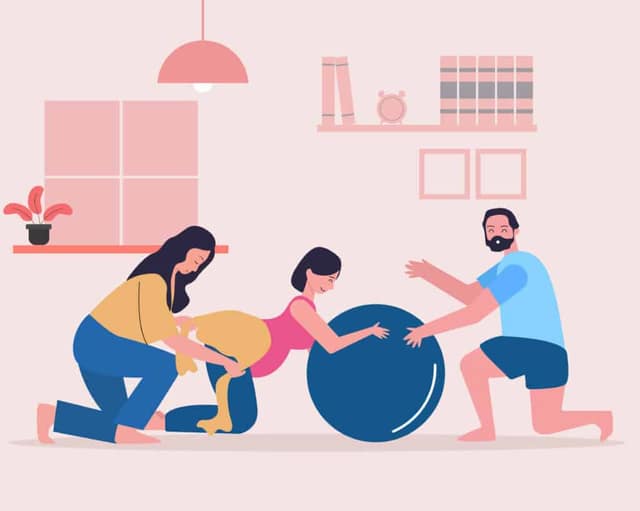
Hypnobirthing has gone from fringe alternative to mainstream childbirth preparation in the past decade. Demi Moore did it in the 1990s. Kate Middleton used it for all three royal births. Today, hospitals across the United States offer these classes alongside Lamaze and Bradley. The promise: a calmer, more controlled, often less medicated birth, achieved through self-hypnosis, breathing, visualization, and deep relaxation rather than fear and tension.
This guide explains what hypnobirthing actually is, what the evidence does and does not support, who it works best for, and how to find a certified instructor in the US. Whether you are giving birth in a hospital, a birth center, or at home, these techniques can complement any plan.
What Is Hypnobirthing, Exactly?
Hypnobirthing is a structured childbirth education program that combines self-hypnosis, breathing techniques, mindfulness, visualization, and partner support to reduce fear, tension, and pain during labor. The most widely known program is the Mongan Method, developed by Marie Mongan in the 1990s and now taught in over 46 countries.
Ready to start your project?
Join +450,000 members who find their co-parent or sperm donor
Start free✓ Free ✓ No commitment ✓ Verified
According to the American Pregnancy Association’s overview of childbirth education classes, this method teaches mothers that if you remove fear and tension, severe pain does not have to be part of labor. The premise rests on what its founder calls the fear-tension-pain cycle: anticipation creates fear, fear tightens muscles, tense muscles work against the body’s natural birthing process, and that resistance produces more pain. Break the cycle, and birth becomes more manageable.
Most hypnobirthing courses run as five 2.5-hour weekly classes or four 3-hour sessions. You learn the techniques in pregnancy, practice them at home, and apply them during labor with your partner as your primary support.
What Does the Evidence Say About Hypnobirthing?
Research on the method is genuinely mixed. The Mayo Clinic notes that some research suggests the technique might be more effective than other interventions at reducing labor pain, though findings are not unanimous.
A 2016 Cochrane systematic review pooled 9 randomized controlled trials with nearly 3,000 women and concluded that the evidence for hypnosis during labor was of low quality due to inconsistency and design limitations, but called for further high-quality research because results were promising. More recent randomized controlled trials, including a 2022 trial published in Health Care for Women International, found that women who completed the training had significantly lower pain scores in latent, active, and transitional labor phases, lower birth intervention rates, shorter deliveries, and higher vaginal delivery and birth satisfaction scores than the control group.
What the evidence consistently supports:
| Outcome | Evidence Strength |
|---|---|
| Reduced fear and anxiety during labor | Strong |
| Improved birth satisfaction and experience | Strong |
| Reduced perception of pain | Moderate |
| Shorter labor duration | Moderate |
| Lower medical intervention rates | Moderate |
| Lower epidural use | Mixed |
| Reduced postpartum depression risk | Emerging |
What this approach is not: a guarantee of pain-free labor, a replacement for medical care, or a magic switch. It is a skill set that takes practice and works best when partners and providers are supportive.
The Core Techniques of Hypnobirthing
The method breaks down into a handful of practiced skills that you build over the weeks of class.
Breathing
You learn two main breaths. Slow, deep breathing through the nose and out through the mouth keeps you relaxed and oxygenated through contractions (called surges or waves in this method). A different “birth breath” replaces the forceful pushing of conventional birth education with a more controlled, breath-led release as your baby descends. Done correctly, breathing alone reduces stress hormones and can lower your perception of pain.
Visualization
You practice picturing positive images: meeting your baby for the first time, opening like a flower, riding waves at the beach, or whatever resonates with you. Visualization functions as a form of self-hypnosis, training your mind to stay focused and calm. Recordings, scripts, and “rainbow relaxation” tracks are part of most courses for daily home practice.
Meditation and Mindfulness
Meditation tunes you into your body and tunes out hospital noise, monitors, and unfamiliar staff. The deeper you can drop into your own internal experience, the better the techniques work. Most students practice 10 to 30 minutes daily in the third trimester.
Positive Language
The method reframes the vocabulary of birth. Contractions become surges or waves. Pain becomes pressure or sensation. Due dates become “guess dates.” This is not magical thinking — language changes how the brain processes physical signals. Reducing fear-charged words measurably reduces fear responses.
How Your Partner Supports Hypnobirthing
A partner is not optional — they are central. The HypnoBirthing Institute recommends partners attend every class. During labor, your partner reads relaxation scripts, applies light touch massage, manages the room environment (lights, music, temperature, who comes in), and serves as your advocate with medical staff.
Partners often report that the method transforms an experience they previously dreaded into one where they have a clear, useful role. For couples expecting through co-parenting or sperm donation, the same approach applies — the support partner can be a co-parent, friend, family member, or doula who provides consistent practical and emotional support.
Where to Take a Hypnobirthing Course in the US
Classes are widely available through three main channels:
- Hospital-based programs at major medical centers including Mayo Clinic, Cleveland Clinic, and many urban academic hospitals.
- Independent certified instructors who teach in person, often in groups of 4 to 8 couples.
- Online courses for couples who prefer to learn at home or live in rural areas without local instructors.
The HypnoBirthing Institute maintains a directory of certified educators across the United States, recognizable by the “Gold Seal”. Costs typically range from $300 to $700 for a full course. Some health insurance plans and HSAs cover childbirth education; check before paying out of pocket.
When to Start Hypnobirthing Classes
Most women begin classes between weeks 25 and 32 of pregnancy. This timing gives you about 8 weeks of class plus 4 to 8 weeks of home practice before your due date. Earlier is fine if you have heightened anxiety or want extra preparation; later is fine if you want the material fresh in your mind. Daily practice from the start is more important than the exact timing.
What If Something Goes Wrong During Labor?
These techniques are not a substitute for medical care. About 20 to 30% of US deliveries involve unplanned interventions including induction, episiotomy, or cesarean section. The techniques remain useful even when birth takes an unexpected turn — breathing, visualization, and self-hypnosis can reduce stress during induction, epidural placement, or even cesarean delivery.
Listen to your medical team. A flexible mindset is part of any good birth plan. Many graduates describe medicated or surgical births that were still calm, controlled, and satisfying because the foundational skills carried over.
Frequently Asked Questions About Hypnobirthing
Does hypnobirthing actually work?
Evidence is mixed but increasingly positive. Most randomized controlled trials show that the method reduces fear, improves birth satisfaction, and modestly reduces pain perception and intervention rates. It is not a guarantee of a pain-free or medication-free birth, but it gives most users meaningful improvements over standard preparation.
Is this method only for natural unmedicated births?
No. The techniques are valuable for any birth scenario including induction, epidural, and cesarean. Many graduates use the breathing and visualization skills during medical interventions to stay calm and focused. It is about being in control of your experience, not about avoiding medical care.
How much does hypnobirthing cost in the US?
Most courses cost between $300 and $700 for a complete program, depending on whether you take it in person, online, or with a private instructor. Hospital-based classes are sometimes cheaper. Some insurance plans cover childbirth education — check your benefits before enrolling.
Can I do it without a partner?
Yes. Single mothers by choice, women whose partners cannot attend, and anyone going solo can do the program successfully. A doula, family member, or close friend can play the support role. Online courses also exist specifically for solo learners.
Is it safe for high-risk pregnancies?
The relaxation techniques are safe for any pregnancy, but the program assumes a generally healthy birth. If you have a high-risk pregnancy, discuss with your obstetrician how the method fits into your medical care plan. The breathing and visualization skills tend to help reduce stress regardless of risk level.
Whether you are preparing for birth with a partner, as a single mother by choice, or through co-parenting, the method is one tool among many to help you arrive at labor calm and confident. If you are exploring co-parenting or family-building options, join CoParents to connect with a community of more than 150,000 future parents and donors making informed family-building choices.