
Sleep training baby is a structured behavioral process that helps an infant learn to fall asleep — and back to sleep — independently, without rocking, feeding or holding. It is recommended by the American Academy of Pediatrics (AAP) and the Sleep Foundation as one of the most effective ways to address bedtime resistance and frequent night wakings in healthy infants.
Between 20% and 30% of infants and young children deal with bedtime resistance or frequent night wakings, so this is a very common family challenge — not a personal failure. The good news: a consistent, evidence-based approach typically yields visible results in 3 to 7 nights.
When can you start sleep training baby?
The Sleep Foundation, Cleveland Clinic and most US pediatricians recommend starting around 6 months, with 4 months as the absolute minimum for healthy, full-term infants. Before that age, your baby still needs frequent night feeds and is not developmentally ready to self-soothe.
Ready to start your project?
Join +450,000 members who find their co-parent or sperm donor
Start free✓ Free ✓ No commitment ✓ Verified
Three biological signs tell you your infant is ready:
- Weight and feeding are stable. Your baby is gaining weight steadily and no longer relies on multiple full night feeds for nutrition.
- Sleep cycles are consolidating. By 3 months, about 90% of babies start sleeping 6 to 8 hour stretches; by 6 months, half can fall back asleep without help.
- Naps are predictable. A roughly 24-hour circadian rhythm has settled in, with consistent wake windows during the day.
If your baby has medical issues, was born prematurely, or has not regained birth weight, talk to your pediatrician before starting any program. The same caution applies if you are a first-time mom juggling postpartum recovery — your wellbeing matters too.
Safe sleep first: AAP rules before any sleep training baby method
According to the American Academy of Pediatrics 2022 safe sleep policy (updated July 2025 from 159 scientific studies), every sleep environment must follow these non-negotiable rules:
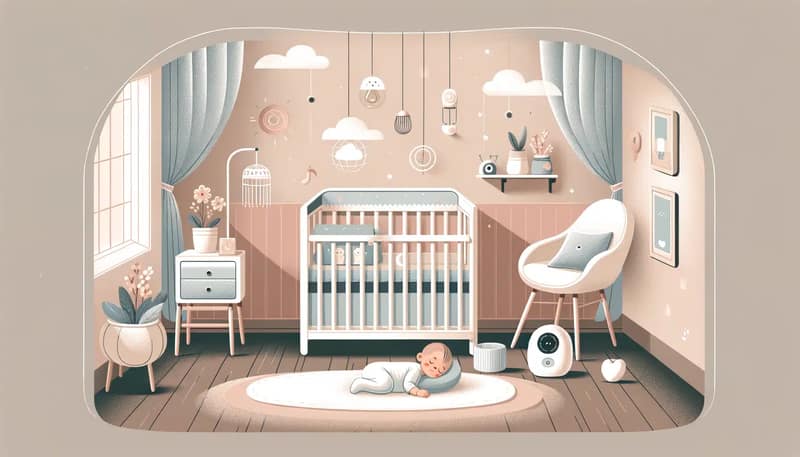
- Back to sleep, every time, until 12 months. Side and stomach positions are unsafe.
- Firm, flat, non-inclined surface (max 10° angle) in a CPSC-compliant crib, bassinet or play yard.
- Bare crib: no pillows, blankets, bumpers, stuffed animals, or weighted swaddles. The AAP advises strongly against weighted sleep sacks as of 2024.
- Room-share, never bed-share, ideally for the first 6 months. Bed-sharing increases SIDS risk by 5 to 10 times in babies under 4 months.
- No couch or armchair sleep — that increases SIDS risk 67-fold.
- Breastfeeding and pacifier use are linked to lower SIDS risk.
Sleep training baby: 4 evidence-based methods
There is no single “right” technique. The four methods below are recognized by US pediatric sleep experts and span a range from highly responsive to fully extinction-based.
| Method | Crying | Time to results | Best for |
|---|---|---|---|
| Ferber (graduated extinction) | Moderate | 3 to 7 nights | Babies 6+ months who fight bedtime |
| Chair method | Low to moderate | 1 to 2 weeks | Parents wanting visible reassurance |
| Pick up / put down | Low | 2 to 3 weeks | Younger infants (4 to 6 months) |
| No tears (Sears, Pantley) | Minimal | 4+ weeks | Parents prioritizing zero crying |
Ferber method: the most studied sleep training baby approach
Developed by Dr. Richard Ferber in 1985 and updated in 2006, the Ferber method — also called graduated extinction — uses progressively longer check-in intervals to teach self-soothing. Per the Sleep Foundation 2025 medical review, the standard schedule is:
- Night 1: wait 3 minutes before first check-in, then 5 minutes, then 10 minutes between subsequent check-ins.
- Night 2: 5, 10, then 12 minutes.
- Night 3: 10, 12, then 15 minutes.
- Night 7: 20, 25, then 30 minutes.
Each check-in lasts 1 to 2 minutes — soft voice, brief reassurance, no picking up, no feeding. Most babies fall asleep independently within 3 to 7 nights. If there is no improvement after a week, the Sleep Foundation advises stopping and reassessing with your pediatrician.
Chair method, pick up / put down, and no tears
The chair method places a parent on a chair next to the crib at bedtime, then gradually moves the chair farther away each night until it is outside the room. The pick up / put down method, popular for younger infants, involves picking the baby up to soothe, then putting them back drowsy but awake, repeating as needed. The no tears method, developed by Dr. William Sears and Elizabeth Pantley, focuses on responsive feeding and rocking, gradually fading sleep associations over weeks.
Sleep training baby: a typical week-by-week timeline
Sleep training usually follows a predictable arc, regardless of method. Here is what to expect:
- Days 1–2: the hardest. Crying may last 45 minutes to over an hour. Stay consistent — inconsistency reinforces the behavior you want to change.
- Days 3–4: visible improvement. Crying time drops sharply, often to under 15 minutes.
- Days 5–7: baby falls asleep with minimal or no crying. Night wakings decrease.
- Week 2: consolidation. Expect occasional “post-extinction bursts” — brief regressions that fade with consistency.
- Weeks 3–4: new habit established. Naps often improve last, so be patient.
This timeline applies to healthy, full-term babies who are ready. If your life after having a baby includes major upheavals like a move or a return to work, consider postponing until things settle.
Sleep training baby: 5 keys to success
- Consistent bedtime routine of 20 to 45 minutes: bath, dim lights, feeding, story, song, then crib. Consistency cues your baby’s circadian rhythm.
- Drowsy but awake. Place your baby in the crib while sleepy, not asleep. Falling asleep in your arms reinforces the dependency you want to undo.
- Boring sleep environment. Dark room, white noise machine, temperature 68–72°F (20–22°C), no screens.
- Both caregivers aligned. Differing approaches between partners are one of the most common sources of conflict for new parents and the #1 cause of failed attempts.
- Track progress. A simple sleep log (bedtime, wake-ups, crying duration) helps you see real progress, especially during the rough first nights.
If you are raising a baby alone, recruiting a relative, friend or postpartum doula for the first 2 to 3 nights makes a huge difference. Hearing a baby cry is harder when you are the only adult in the home.
Frequently asked questions
Does sleep training baby cause harm?
No. Multiple peer-reviewed studies, including a 5-year follow-up published in Pediatrics, found no negative effects on attachment, mental health or stress hormone levels in children who underwent sleep training methods compared with controls. The approach is endorsed by the AAP, the American Academy of Sleep Medicine and the Sleep Foundation as safe for healthy, full-term infants from 6 months.
How long does sleep training baby take?
With graduated extinction (Ferber), most families see clear results in 3 to 7 nights and full consolidation within 2 weeks. Gentler methods like no tears or pick up / put down typically take 3 to 6 weeks. Consistency, not speed, is what determines success.
Can sleep training baby work with breastfeeding?
Yes. Sleep training is about teaching self-soothing for non-feeding wakings — not eliminating night feeds. Until 9 months, most babies still need 1 to 2 night feeds. Keep substantial feeds, drop comfort nursings, and put baby back in the crib drowsy but awake after each feed.
When should you stop sleep training baby?
Stop and reassess if there is no improvement after 7 consecutive nights, if your baby is sick, teething severely, or if crying lasts more than 90 minutes per attempt. Pause during major life transitions — moves, daycare starts, sibling arrivals — and resume once routine is restored.
Does sleep training baby work for naps too?
Yes, but naps usually improve 1 to 2 weeks after night sleep does. Apply the same method during nap time, but cap “no result” attempts at 30 to 45 minutes — if your baby has not fallen asleep, get them up and try again at the next wake window.
Sleep training baby is one of the most rewarding investments you can make in your family’s wellbeing. Better sleep means a calmer parent, a happier baby, and a stronger relationship — whether you are co-parenting, parenting solo, or part of a couple. To connect with other parents and co-parents going through the same milestones, join CoParents.com today and become part of a global community of more than 150,000 members building families their own way.