
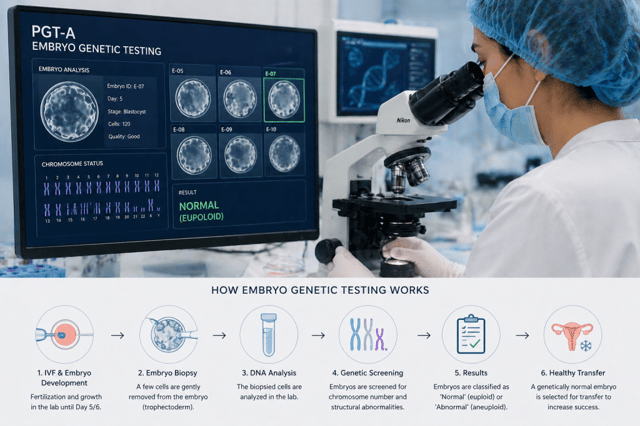
Genetic testing embryos created during in vitro fertilization (IVF) is a laboratory technique used to detect chromosomal or single-gene abnormalities before transfer. The official term in 2026 is preimplantation genetic testing (PGT), which has replaced the older “PGD/PGS” terminology used before 2017. The aim is to select embryos with the highest chance of healthy implantation and live birth.
According to the ASRM 2024 Committee Opinion, the proportion of US IVF cycles using PGT rose from 14% in 2014 to 44% in 2019 and continues to grow. Yet the same opinion is clear: PGT is not recommended as a routine screening test for every IVF patient. Choosing it well requires understanding what each type of test actually detects.
Genetic testing embryos: PGT-A, PGT-M and PGT-SR explained
PGT in 2026 falls into three distinct categories defined by the American Society for Reproductive Medicine (ASRM) and the European Society of Human Reproduction and Embryology (ESHRE):
Ready to start your project?
Join +450,000 members who find their co-parent or sperm donor
Start free✓ Free ✓ No commitment ✓ Verified
| Type | What it detects | Best for |
|---|---|---|
| PGT-A (aneuploidy) | Abnormal number of chromosomes (e.g. Down syndrome, Trisomy 18) | Women 35+, recurrent miscarriage, recurrent implantation failure |
| PGT-M (monogenic) | Single-gene disorders (cystic fibrosis, Huntington’s, Tay-Sachs, BRCA, sickle cell) | Known carriers of a specific genetic disease |
| PGT-SR (structural) | Chromosomal translocations and structural rearrangements | Parents with a karyotyped chromosomal rearrangement |
A fourth and controversial category, PGT-P (polygenic), aims to predict risk for adult-onset diseases like diabetes or hypertension. ASRM concluded in December 2025 that PGT-P is not ready for clinical use due to insufficient predictive validity and ethical concerns.
How does genetic testing embryos work step by step?
The process happens after fertilization, while the embryos are still in the laboratory. PGT cannot be performed during natural conception — IVF is required.
- Fertilization in the lab. Eggs are retrieved and fertilized with the partner’s or donor sperm, usually via ICSI when PGT-M is planned.
- Blastocyst culture. Embryos develop for 5 to 6 days until they reach the blastocyst stage and contain hundreds of cells.
- Trophectoderm biopsy. The embryologist removes 5 to 10 cells from the trophectoderm — the part of the blastocyst that will form the placenta, not the baby.
- Whole-genome amplification. The biopsied DNA is amplified, then analyzed by next-generation sequencing (NGS), the dominant platform in 2026.
- Cryopreservation. Embryos are frozen by vitrification while awaiting results, which take 7 to 14 days.
- Frozen embryo transfer. A single euploid embryo (with the correct chromosome count) is transferred in a later cycle, typically 4 to 8 weeks afterwards.
Who should consider genetic testing embryos?
The 2024 ASRM committee opinion and the 2025 review published in Frontiers in Genetics by NIH PubMed Central identify four clear indications:
- Advanced maternal age (35 and over): the rate of chromosomally abnormal embryos rises from about 31% under 35 to over 70% beyond age 40. The ASRM data show implantation rates of 53.7% with PGT-A versus 7.4% without for women aged 43+.
- Recurrent pregnancy loss: approximately 50% of first-trimester miscarriages are caused by chromosomal abnormalities. PGT-M can shorten time to a healthy pregnancy.
- Known monogenic disease: PGT-M can screen for over 600 single-gene conditions including cystic fibrosis, Huntington’s chorea, Tay-Sachs, sickle cell disease, BRCA1/BRCA2 mutations, and Fragile X syndrome.
- Balanced chromosomal rearrangements: couples with a translocation or inversion benefit from PGT-SR to avoid recurrent miscarriages.
Women planning a perimenopause pregnancy often combine donor egg IVF with PGT, although ASRM notes that genetic testing embryos from young donors offers limited clinical benefit and is generally not cost-effective.
How much does genetic testing embryos cost in 2026?
PGT is an out-of-pocket expense in roughly 95% of US insurance plans, even when IVF itself is covered. National 2026 averages:
- PGT-A: $4,000 to $6,000 per IVF cycle (biopsy + lab fees), usually $300 to $500 per additional embryo tested.
- PGT-M: $7,000 to $12,000 per cycle, including a $900 to $1,900 pre-test workup to design the family-specific probe.
- PGT-SR: $5,000 to $8,000 per cycle, depending on the complexity of the rearrangement.
- Frozen embryo transfer (FET): add $4,000 to $5,000 — almost always required since embryos are frozen during testing.
The complete bill for IVF + PGT-A + FET in 2026 typically reaches $28,000 to $35,000, with major-metro clinics in NYC, LA and SF charging up to $9,000 for PGT-A alone. California’s SB 729 fertility coverage mandate, effective January 2026, may cover part of these costs for residents with qualifying employer insurance.
Genetic testing embryos: benefits, limits and what the data really says
Two large multicenter randomized controlled trials in 2019 (STAR) and 2021 (Yan et al., NEJM) found that cumulative live birth rates were similar between IVF with PGT-A and conventional IVF in good-prognosis women. The benefit shows up mainly per transfer, not per cycle:
- PGT-A reduces miscarriage rates from 27.7% to 13.6% in women 38–40, and from 51.5% to 18.3% in women 43+.
- It cuts time to pregnancy by avoiding failed transfers of aneuploid embryos.
- It enables single embryo transfer (SET) with confidence, lowering the risk of twin and triplet pregnancies.
- It reduces the emotional and financial cost of recurrent loss after IVF.
Limits also matter. Mosaic embryos — with both normal and abnormal cells — appear in 15.8% to 17.4% of biopsied blastocysts. Some mosaics implant and produce healthy children, raising concerns about discarding viable embryos. False-positive aneuploid diagnoses occur in 0% to 2.4% of cases. And about 1 in 6 embryos labeled abnormal could potentially have produced a healthy live birth.
What about IVF success rates with genetic testing embryos?
Per-transfer live birth rates with a euploid embryo confirmed by PGT are 54% to 55% across age groups, according to 2025 SART data. That’s the major selling point: once you have a tested euploid embryo, your age matters far less. The challenge for older women is producing a euploid embryo in the first place. For more on age-stratified outcomes, see our guide on IVF success rate.
Frequently asked questions
Is genetic testing embryos covered by insurance in 2026?
Rarely. Around 95% of US health plans exclude PGT even when IVF is covered, classifying it as elective. Approval rates are higher for documented carriers of severe genetic diseases (PGT-M: 30 to 40% approval) and for confirmed chromosomal rearrangements (PGT-SR: 25 to 35%). California residents with employer insurance may benefit from SB 729 starting in 2026.
Does genetic testing embryos harm the embryo?
Trophectoderm biopsy at the blastocyst stage removes only future placental cells, not future baby cells. ASRM-cited studies show no significant differences in birth weight, preterm birth, neonatal complications or childhood neurodevelopment up to age 9 between PGT and non-PGT IVF babies. Some observational data suggest a slightly higher rate of preeclampsia and preterm delivery, which require further research.
How long does genetic testing embryos take?
From egg retrieval to a confirmed euploid embryo result typically takes 2 to 3 weeks. The biopsy is performed on day 5 or 6, embryos are frozen, and the genetics laboratory returns results within 7 to 14 days. The transfer happens in a subsequent cycle, usually 4 to 8 weeks later.
Can genetic testing embryos determine sex?
Yes. PGT-A reports the X and Y chromosomes, so the sex of each embryo is known. Elective sex selection for non-medical reasons is legal in the US but raises ethical concerns. ASRM data show IVF cycles using PGT for sex selection produced a male/female ratio of 164 versus a national baseline of 105, prompting ongoing professional debate.
Can lesbian couples and single women use genetic testing embryos?
Yes. PGT is available to anyone undergoing IVF, including lesbian couples pursuing reciprocal IVF and single women using donor eggs or donor sperm. Same-sex couples often combine PGT-A with a known sperm donor found through a co-parenting platform.
Whether you are exploring IVF with PGT, donor sperm or a co-parenting arrangement, the most affordable starting point is often a known donor or shared parent. Join CoParents.com today and connect with thousands of members worldwide who are ready to help you build your family — through co-parenting, sperm donation or shared parenthood.