
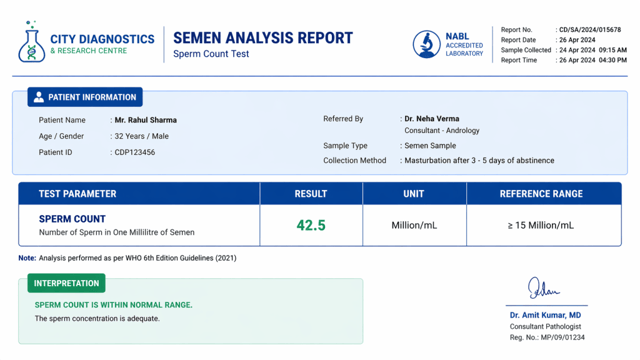
Sperm count test: what it is and why it matters
A sperm count test measures the number, movement, and shape of sperm cells in a semen sample. It is the single most important exam used to evaluate male fertility. Doctors order it when a couple has been trying to conceive without success, when a man wants to donate sperm, or after a vasectomy to confirm the procedure worked.
According to the American College of Obstetricians and Gynecologists guidance on evaluating infertility, male factor accounts for roughly 40 to 50 percent of infertility cases in heterosexual couples. That is why a basic semen analysis should be one of the first tests ordered when conception fails after 12 months of unprotected sex (or 6 months if the female partner is over 35).
A standard sperm count test looks at five main parameters: concentration, total sperm number, motility, morphology, and semen volume. Each one tells your doctor something different about your reproductive health. Reading the results together gives a much clearer picture than focusing on a single number.
Ready to start your project?
Join +450,000 members who find their co-parent or sperm donor
Start free✓ Free ✓ No commitment ✓ Verified
What is considered a normal sperm count in 2026?
The reference values most labs use today come from the World Health Organization. In 2021, the WHO published the sixth edition of its laboratory manual for human semen analysis, which remains the global standard in 2026. You can consult the full reference document on the WHO laboratory manual for the examination and processing of human semen, sixth edition.
Here are the lower reference values currently used by most fertility clinics:
| Parameter | WHO 2021 lower reference |
|---|---|
| Semen volume | 1.4 mL |
| Sperm concentration | 16 million per mL |
| Total sperm number | 39 million per ejaculate |
| Total motility | 42 percent |
| Progressive motility | 30 percent |
| Normal morphology | 4 percent |
| Vitality (live sperm) | 54 percent |
These numbers are not a strict pass-fail line. They represent the fifth percentile of fertile men whose partners conceived within 12 months. Plenty of men below these thresholds still father children naturally, and some men above them struggle to conceive. However, falling below several values at once is a meaningful signal that further evaluation is needed.
How is a sperm count test performed?
A sperm count test can be done two ways: at a clinical andrology laboratory or with an at-home kit. Both have advantages, and they answer slightly different questions.
The clinical lab analysis
This is the gold standard. You will be asked to abstain from ejaculation for 2 to 5 days before the test. Then you provide a semen sample, usually at the clinic in a private room, by masturbation into a sterile cup. Some labs accept samples collected at home if you can deliver them within 30 to 60 minutes while keeping them at body temperature.
The lab examines the sample within an hour of collection. Technicians measure volume, pH, viscosity, concentration, motility, morphology, and the presence of white blood cells. According to the AUA/ASRM guideline on diagnosis and treatment of male infertility, results are most reliable when at least two analyses are performed several weeks apart, because sperm parameters fluctuate naturally from one ejaculation to the next.
A full clinical semen analysis typically costs between 50 and 200 dollars in the United States, and is often covered by insurance when ordered for infertility evaluation.
At-home sperm count test kits
Home kits like SpermCheck Fertility offer a simpler, private screening option. They are sold over the counter and online for around 30 to 50 dollars. Manufacturers claim accuracy above 98 percent compared to lab microscopy, but these kits only measure sperm concentration — not motility, morphology, or volume.
To use one, you abstain for at least 48 hours, ejaculate into the provided cup, mix the sample with the supplied solution, and apply a few drops to the test device. Results appear within 7 to 10 minutes, similar to a pregnancy test. A positive result means concentration is above the threshold (usually 20 million per mL); a negative result means it is below.
A home sperm count test is a useful first step, but it should never replace a full lab analysis if you are actively trying to conceive or have concerns about fertility.
What the five key parameters reveal
Sperm concentration and total count
Concentration is the number of sperm per milliliter of semen, while total count is the number per entire ejaculate. A normal ejaculate produces roughly 39 million to 928 million sperm in total. Counts below 16 million per mL are classified as oligozoospermia. Complete absence of sperm is called azoospermia and affects about 1 percent of all men and 10 to 15 percent of infertile men.
Sperm motility
Motility is the percentage of sperm that move, and how well they move. To reach an egg, sperm need progressive forward motion in a straight line. The WHO sixth edition uses two grades: progressive and non-progressive. Below 30 percent progressive motility is considered asthenozoospermia. Sperm that swim in circles, vibrate in place, or do not move at all cannot reach the fallopian tube.
Sperm morphology
Morphology examines the size and shape of sperm under a microscope using strict Kruger criteria. A normal sperm has an oval head, a midpiece, and a long tail. Defects can affect any of these. The WHO 2021 lower reference for normal forms is just 4 percent, which surprises many men — but most ejaculates contain a high proportion of abnormal sperm even in fertile males. Teratozoospermia means the percentage of normal forms is below this threshold.
Semen volume and pH
Normal ejaculate volume ranges from 1.4 to 6 mL. Lower volumes can indicate a problem with the seminal vesicles, prostate, or ejaculatory ducts. Semen pH should be between 7.2 and 8.0; values outside this range may suggest infection or obstruction.
Vitality
Vitality measures how many sperm are actually alive, regardless of whether they move. This test is performed when total motility is below 40 percent to distinguish dead sperm from immobile but living ones. Below 54 percent live sperm is called necrozoospermia.
How to prepare for an accurate sperm count test
Preparation matters more than most men realize. Therefore, follow these guidelines for the most accurate results:
- Abstain from ejaculation for 2 to 5 days before the test — not less, not more.
- Avoid alcohol and recreational drugs for at least 5 days beforehand.
- Do not start any new medications, supplements, or hormone treatments without telling your doctor.
- If you have had a fever or illness in the past 3 months, mention it: spermatogenesis takes about 74 days, so a recent infection can temporarily lower your count.
- Avoid hot tubs, saunas, and very hot baths in the week before the test.
- Collect the entire ejaculate, especially the first portion which contains the highest sperm concentration.
Moreover, because results fluctuate, doctors usually request a second sperm count test two to three weeks after the first if any abnormality is detected. A single low result rarely justifies a diagnosis on its own.
What if your sperm count is low?
A low result can feel discouraging, but it is rarely a final verdict. Many causes of reduced sperm production are reversible. Lifestyle factors are the most common culprits and the easiest to address: smoking, excessive alcohol, obesity, chronic stress, heat exposure, and certain medications can all lower sperm parameters. Quitting smoking alone can improve sperm count by up to 50 percent within three months.
If lifestyle changes do not improve the next test, your doctor may order additional exams: hormone blood tests (FSH, LH, testosterone, prolactin), a scrotal ultrasound to look for varicocele, genetic testing, or in some cases sperm DNA fragmentation analysis. Conditions like varicocele, hormonal imbalance, or infection are often treatable. For more practical guidance, see our detailed article on 14 proven ways to increase sperm count, and discover which sperm count foods can boost male fertility naturally.
When natural conception remains difficult despite treatment, assisted reproductive technologies such as IUI, IVF, or ICSI become valuable options. In severe cases, using a sperm donor can offer a practical path to parenthood. Many men and couples explore donor conception through community platforms like CoParents.com, which connects intended parents with donors and co-parents in a supportive environment.
Frequently asked questions about the sperm count test
How long does a sperm count test take to get results?
A clinical lab usually delivers results within 1 to 3 business days. Home kits give results in 7 to 10 minutes but only measure concentration.
Can a sperm count test be wrong?
Yes. Sperm parameters vary significantly from one sample to another, even in the same man over a few weeks. That is why doctors recommend at least two tests spaced 2 to 3 weeks apart before drawing any conclusions. Illness, fever, stress, and recent ejaculation frequency all influence the result.
Is a sperm count test painful?
No. A sperm count test is non-invasive. The only step required is providing a semen sample by masturbation, either at the clinic or at home.
How much does a sperm count test cost in the United States?
A clinical semen analysis typically costs 50 to 200 dollars without insurance. At-home kits cost 30 to 50 dollars. Many insurance plans cover semen analysis when ordered for infertility evaluation.
At what age should men consider a sperm count test?
Any man trying to conceive without success after 12 months should get tested. Men over 40, or those with known risk factors (varicocele, undescended testicle, chemotherapy history, exposure to toxins), may benefit from earlier screening even before trying to conceive.
If your sperm count test shows low fertility and you are exploring alternative paths to parenthood, sperm donation may be the right option. Join our community to find a verified donor near you and start your family journey with confidence. Create your free CoParents account today.