
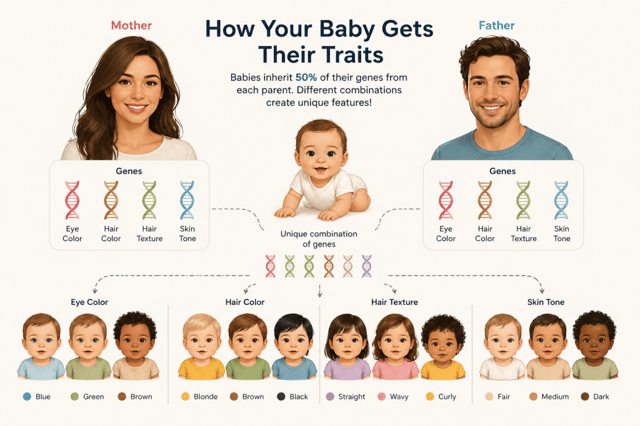
Baby genetics determines far more than eye color. The unique combination of DNA your child inherits at conception shapes their physical traits, their predispositions to certain health conditions, and even subtle aspects of their personality. Understanding baby genetics helps future parents make informed choices about screening, donor selection, and family planning.
This guide explains how baby genetics actually works, what genes can and cannot predict, the role of genetic screening during pregnancy, and the modern tools available when you want to know more before, during, or after conception.
How Baby Genetics Works: The Basics
Every human cell carries 46 chromosomes arranged in 23 pairs. According to the National Human Genome Research Institute Chromosomes Fact Sheet, half of these chromosomes come from the biological mother and half from the biological father. Each chromosome holds hundreds to thousands of genes, the segments of DNA that code for proteins and ultimately for traits.
Ready to start your project?
Join +450,000 members who find their co-parent or sperm donor
Start free✓ Free ✓ No commitment ✓ Verified
Your baby is not a 50-50 photocopy of you and your partner. The shuffling of genes during egg and sperm formation, called meiosis, creates a unique combination every time. That is why siblings born to the same parents look different from each other and have different talents, allergies, and risk profiles.
A Quick Glossary
| Term | What It Means |
|---|---|
| Chromosome | Thread-like structure carrying DNA in the cell nucleus |
| Gene | Segment of DNA that codes for a specific trait or function |
| Allele | One of several variants of the same gene |
| Dominant trait | Expressed when only one copy is inherited |
| Recessive trait | Expressed only when both copies are inherited |
| Mutation | A change in the DNA sequence that can be passed on |
Can Baby Genetics Predict Eye Color, Height, or Hair?
Partly. Some traits follow predictable patterns, while others are polygenic, meaning many genes interact in ways that science is still mapping.
Eye color, once taught as a simple dominant-recessive trait, is actually controlled by at least 16 genes. Two blue-eyed parents can occasionally have a brown-eyed child. Height is influenced by more than 700 genetic variants plus nutrition and overall health during childhood. Hair color, skin tone, and even ear shape involve dozens of genes that may skip generations or recombine in surprising ways.
When biological mum and dad come from different ethnic backgrounds, baby genetics becomes even harder to predict. Your child might inherit features from a great-grandparent neither of you has met. That unpredictability is part of what makes every baby a genuinely new person.
Baby Genetics and Medical Conditions
The clinical side of baby genetics is what most expectant parents want to understand. Inherited conditions fall into four broad categories.
Single-gene disorders happen when a variant in one gene causes the condition. Examples include cystic fibrosis, sickle cell disease, and Huntington’s disease. According to the MedlinePlus guide to inheritance patterns, these conditions can be inherited as autosomal dominant, autosomal recessive, or X-linked depending on the gene involved.
Chromosomal conditions arise when a baby has too many or too few chromosomes, or a structural change in a chromosome. The most common is Down syndrome, also called Trisomy 21. The CDC reports that about 5,775 babies are born with Down syndrome in the United States each year, roughly 1 in 700 births.
Multifactorial conditions involve many genes plus environmental factors. Heart disease, diabetes, and most cancers fall into this group. Family history matters, but lifestyle and environment can reduce or amplify risk.
New mutations are spontaneous DNA changes that were not present in either parent. They can cause unexpected conditions even when family history is clear.
Genetic Screening During Pregnancy
Modern medicine offers several ways to assess baby genetics before birth. The right test depends on your stage of pregnancy, family history, and personal preferences.
Before Pregnancy: Carrier Screening
Carrier screening is a simple blood or saliva test that checks whether you or your partner carry recessive variants for conditions like cystic fibrosis or spinal muscular atrophy. It is especially valuable when you are using a sperm donor or egg donor, since reputable banks already screen donors for genetic abnormalities and markers.
During IVF: Preimplantation Genetic Testing (PGT)
If you are conceiving through IVF, embryos can be biopsied at the blastocyst stage and tested for chromosomal abnormalities (PGT-A), single-gene disorders (PGT-M), or structural rearrangements (PGT-SR). Only embryos that pass screening are transferred to the uterus.
During Pregnancy: Screening and Diagnostic Tests
Non-invasive prenatal testing (NIPT) analyzes fetal DNA fragments in the mother’s blood from 10 weeks onward. It screens for Down syndrome, Trisomy 18, Trisomy 13, and sex chromosome conditions with high accuracy. If NIPT or other screens flag a higher risk, diagnostic tests like chorionic villus sampling (CVS) or amniocentesis can confirm the diagnosis by examining fetal cells directly.
| Test | When Performed | What It Detects |
|---|---|---|
| Carrier screening | Before or early pregnancy | Recessive single-gene conditions |
| PGT-A | During IVF (embryo) | Chromosomal abnormalities |
| NIPT | From 10 weeks | Down syndrome, Trisomy 13/18 |
| CVS | 10–13 weeks | Most chromosomal & single-gene conditions |
| Amniocentesis | 15–20 weeks | Most chromosomal & single-gene conditions |
Baby Genetics, Donor Sperm, and Egg Donation
If you are building your family with donor gametes, baby genetics takes center stage in the matching process. Reputable sperm and egg banks now screen donors for more than 250 genetic conditions using expanded carrier screening panels. CoParents members who choose a known donor through the platform can request the same level of testing for full transparency on baby genetics.
Many intended parents using a sperm donor combine carrier screening of the recipient with donor screening to rule out matching recessive variants. This dramatically reduces the risk of the baby inheriting a serious recessive condition.
The Ethics of Genetic Editing and Designer Babies
As CRISPR and related technologies advance, the line between screening for serious disease and selecting cosmetic traits like the sex of a baby gets ethically blurry. Most countries restrict embryo editing to research or to preventing serious genetic disorders. Sex selection is permitted in the United States and a handful of other countries but banned in the UK, France, Canada, China, India, and most of Europe.
Public health authorities including the World Health Organization and the National Academies of Sciences have called for international consensus before heritable genetic modifications enter clinical practice. For now, baby genetics remains shaped by chance, partner selection, and screening, not by editing. Some experimental procedures, like the world’s first three-parent IVF baby, show how rapidly the field is evolving.
Frequently Asked Questions About Baby Genetics
Can baby genetics be tested before birth?
Yes. Non-invasive prenatal testing (NIPT) can screen for major chromosomal conditions from 10 weeks of pregnancy using a simple blood draw from the mother. Diagnostic tests like CVS and amniocentesis can confirm specific conditions by examining fetal cells directly.
Do baby genetics come more from the mother or the father?
Neither. Each parent contributes 23 chromosomes, so half of the baby’s nuclear DNA comes from each side. The exception is mitochondrial DNA, which passes only from the mother. The Y chromosome passes only from father to son.
Can two carriers of a recessive condition have a healthy baby?
Yes. When both parents carry one copy of a recessive variant, each pregnancy has a 25% chance of an affected baby, a 50% chance of a carrier baby like the parents, and a 25% chance of a baby with no copies of the variant.
Why do siblings look so different despite shared baby genetics?
Each egg and sperm contains a randomly shuffled half of the parent’s DNA. Two siblings inherit different combinations from the same gene pool, which is why they can have different eye colors, heights, and personalities even with identical biological parents.
Can lifestyle change baby genetics during pregnancy?
The DNA sequence cannot change after conception, but how genes are expressed (called epigenetics) is influenced by the mother’s nutrition, stress, smoking, and exposure to environmental toxins during pregnancy. That is why prenatal care matters even when family history is reassuring.
Whether you are starting your family through natural conception, IVF, or sperm donation, understanding your child’s genetic story gives you a head start. If you are looking for a sperm donor, an egg donor, or a co-parent, join CoParents to find a donor and connect with a community of more than 150,000 future parents and donors making informed family-building choices.