
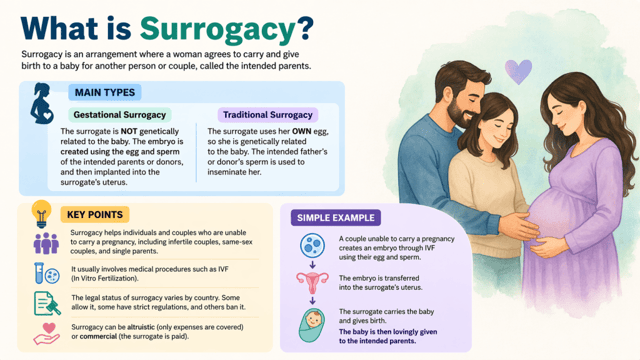
What is surrogacy: a clear definition
The question what is surrogacy has a simple answer: it is an arrangement in which a woman, called a surrogate or gestational carrier, agrees to carry and deliver a baby for another person or couple, known as the intended parents. Understanding what is surrogacy matters because it is one of the most regulated forms of assisted reproductive technology, and it offers a path to parenthood when pregnancy is medically impossible or unsafe for the intended mother.
In 2026, the question of what is surrogacy continues to attract growing attention in the United States, Canada, and several European countries. According to the American College of Obstetricians and Gynecologists Committee Opinion on family building through gestational surrogacy, this practice allows individuals or couples to become parents despite circumstances in which carrying a pregnancy is biologically impossible or medically contraindicated.
When asking what is surrogacy, you also need to know there are two main types: traditional and gestational. The difference matters enormously, both medically and legally. Most reputable clinics in the US, Canada, and the UK now perform only gestational surrogacy because of its clearer legal and ethical framework.
Ready to start your project?
Join +450,000 members who find their co-parent or sperm donor
Start free✓ Free ✓ No commitment ✓ Verified
The two types of surrogacy explained
Gestational surrogacy
In gestational arrangements, the carrier has no genetic link to the baby. An embryo is created in a fertility clinic through in vitro fertilization (IVF), using the egg and sperm of the intended parents, donors, or a combination of both. The embryo is then transferred to the carrier’s uterus, where it develops to term.
Because the surrogate shares no DNA with the child, parental rights are generally easier to establish and contest is rare. This is the model used in over 95 percent of US arrangements today. When professionals explain what is surrogacy in modern practice, they almost always mean this gestational version. Most reputable agencies, fertility clinics, and ethics boards consider it the medical and legal standard.
Traditional surrogacy
In traditional arrangements, the carrier provides her own egg, which is fertilized by the intended father’s sperm or a donor’s sperm through artificial insemination. This makes the surrogate the genetic mother of the child. Although it is simpler and cheaper, traditional surrogacy is now rarely practiced in the United States. The legal and emotional risks are significantly higher, and most clinics decline to offer it. Several states explicitly prohibit it.
Why intended parents choose surrogacy
Intended parents who research what is surrogacy usually do so for very specific reasons. Common medical situations include:
- Absence of a uterus due to hysterectomy or congenital condition (such as MRKH syndrome)
- Severe uterine scarring, fibroids, or Asherman syndrome
- Repeated miscarriages or multiple failed IVF cycles
- Serious health conditions where pregnancy would be dangerous (heart disease, certain cancers, lupus)
- Same-sex male couples and single men who want a biological child
Pelvic inflammatory disease, endometriosis, and untreated sexually transmitted infections remain leading causes of female infertility worldwide. Many of these conditions damage the fallopian tubes or uterus permanently. Therefore, when patients ask their doctor what is surrogacy and whether they qualify, the answer is often yes if these conditions apply.
How does the surrogacy process actually work?
A typical gestational journey takes between 15 and 24 months from start to finish. Anyone wondering what is surrogacy in practical terms should understand the main steps:
- Initial consultation and screening. Intended parents meet with a fertility clinic or surrogacy agency to discuss medical history, goals, and budget.
- Matching with a gestational carrier. The agency reviews profiles and proposes carriers who meet medical, psychological, and lifestyle criteria.
- Medical and psychological screening. The surrogate undergoes thorough medical exams, infectious disease testing, and mental health evaluation. The intended parents do as well.
- Legal contracts. Both parties sign a detailed agreement covering compensation, medical decisions, parental rights, and contingencies. Each party must have independent legal counsel.
- IVF and embryo transfer. Eggs are retrieved, fertilized, and the resulting embryo is transferred into the surrogate’s uterus.
- Pregnancy and prenatal care. The carrier receives standard obstetric care while staying in close contact with the intended parents.
- Birth and parental rights. Pre-birth or post-birth orders confirm the intended parents as the legal parents on the birth certificate.
The 2022 ASRM committee opinion on practices using gestational carriers recommends that carriers be between 21 and 45 years old, have already carried at least one healthy term pregnancy, have no more than five previous deliveries (or three cesareans), and have a stable home environment with strong social support.
How much does surrogacy cost in 2026?
Cost is one of the first concerns when people learn what is surrogacy. It remains one of the most expensive paths to parenthood. Total costs in the United States in 2026 typically range from $120,000 to $220,000, depending on the state, the surrogate’s experience, and whether donor gametes are needed.
Here is a breakdown of the main expense categories:
| Expense category | Typical range (USD) |
|---|---|
| Agency fees | $25,000 – $60,000 |
| Surrogate base compensation | $45,000 – $70,000 |
| IVF and medical care | $25,000 – $50,000 |
| Legal fees (both parties) | $10,000 – $25,000 |
| Surrogate health insurance | $12,000 – $30,000 |
| Escrow and miscellaneous | $5,000 – $15,000 |
States with strong legal protections like California, Illinois, and New York tend to sit at the higher end of the range. Texas and Florida often offer more affordable options. Insurance rarely covers full surrogacy programs, although some plans pay for prenatal care and delivery once the carrier transitions to her own OB/GYN around week 12.
International journeys in countries like Mexico, Colombia, or Georgia can cost considerably less, but legal protections are weaker, and bringing the baby home can become complicated. For this reason, anyone investigating what is surrogacy abroad should consult an attorney experienced in cross-border reproductive law before signing anything.
Where is surrogacy legal in 2026?
The legal landscape of what is surrogacy varies enormously from one country to another, and even from one US state to another. Laws change frequently, so always verify current rules before starting any arrangement.
In the United States, surrogacy-friendly states include California, Illinois, Connecticut, Nevada, Maine, New Hampshire, Washington, and Colorado. New York legalized commercial gestational surrogacy in 2021, and Michigan followed in 2024. A handful of states still restrict or limit contracts, so legal advice from an attorney familiar with assisted reproduction is essential.
Internationally, surrogacy is legal in Canada (altruistic only), the United Kingdom (altruistic only), Greece, Israel, Ukraine, and parts of Mexico. It is banned or severely restricted in France, Germany, Italy, Spain, and most of the Middle East. Cross-border arrangements raise additional legal complications around citizenship, parental recognition, and exit visas for the newborn.
For more on the legal framework around assisted reproduction, see our guide on sperm donor laws in the US.
The role and rights of the gestational carrier
Understanding what is surrogacy also means understanding the carrier’s role. A gestational carrier provides one of the most generous gifts imaginable. However, her role is also legally and emotionally complex. She retains full bodily autonomy throughout the pregnancy, including all medical decisions about her own care.
Most carriers are motivated by altruism rather than money alone. Studies cited by the ASRM suggest that the majority of surrogates report their experience as positive and meaningful, even years later. Nevertheless, the emotional impact of handing over a newborn should never be underestimated, which is why pre- and post-pregnancy counseling is mandatory at reputable agencies.
If you are considering becoming a surrogate, take time to research thoroughly, consult experienced agencies, and discuss the decision with your family. Our article on essential questions to ask before starting a surrogacy journey covers the most important issues to clarify upfront. You can also explore the broader landscape of family-building options through CoParents.com, where intended parents, donors, and co-parents connect within a supportive community.
Frequently asked questions about surrogacy
What is surrogacy in simple terms?
In the simplest terms, what is surrogacy comes down to this: a woman carries a pregnancy and delivers a baby for someone else, the intended parent or parents, who become the child’s legal family at birth. In modern gestational arrangements, the carrier has no genetic link to the child.
Is the surrogate the biological mother of the baby?
In gestational arrangements, no. The carrier has no genetic link to the child because the embryo is created from the eggs and sperm of the intended parents or donors. In traditional surrogacy, yes, because the carrier provides her own egg. This is one reason traditional arrangements are now rare.
How long does the surrogacy process take?
A complete journey usually takes 15 to 24 months from initial consultation to birth. Matching with a carrier alone can take 3 to 9 months, followed by 3 to 6 months of medical and legal preparation, then a 9-month pregnancy.
Can same-sex couples or single people use surrogacy?
Yes. In states and countries where it is legal, same-sex male couples, lesbian couples, and single individuals can pursue this path. When LGBTQ+ intended parents ask what is surrogacy and whether they qualify, the answer in most surrogacy-friendly states is yes, with some additional legal steps in certain jurisdictions.
Is surrogacy covered by insurance?
Most US health insurance plans do not cover the full process directly. However, some policies may cover prenatal care, delivery, and complications under the surrogate’s own coverage. Specialized maternity insurance riders are usually purchased separately, costing $12,000 to $30,000.
Now that you know what is surrogacy and how the process works, the next step may be connecting with a community of intended parents, donors, and co-parents who share your goals. Create your free CoParents account today to start exploring family-building options and meet people on the same journey.